

History of Nature Museum
The 20th century was a period of flourishing for zoological science in Kazakhstan—a time of scientific inquiry and discovery. At the beginning of the century, the foundation for fundamental zoological research was laid.
Scientific paleontological materials collected in Kazakhstan from the 1940s to the early 1960s formed the basis for the idea of creating the Kazakhstan Museum of Nature at the Institute of Zoology. The materials displayed in the Museum of Nature were collected by well-known archaeologists, geologists, and zoologists of Kazakhstan during field expeditions in the 1950s and 1960s. Some of these specimens are unique and cannot be found anywhere else in the world. Kazakhstan became internationally known thanks to remarkable discoveries made in the Turgai Lowland and Tekes Lowland, as well as in the vicinity of the North Aral Sea, the Ishim River, and the Irtysh River.
Opening of the Museum
The Scientific Council of the Institute of Zoology decided not only to store the collected materials related to the fauna of Kazakhstan in storage facilities, but also to present the best specimens to the public in the exhibitions of the future Museum of Nature. In 1957, following a decision by the Presidium of the Academy of Sciences of the Kazakh SSR, work began on creating the museum’s exhibitions at the Academy of Sciences. Academician Kanysh Imantayevich Satbayev supported this proposal, and on April 29, 1961, the museum was officially opened (Photo 1).
The main purpose of the museum is to demonstrate the rich diversity of Kazakhstan’s animal world, from ancient geological eras to the present day, and from the simplest organisms to the most complex life forms.
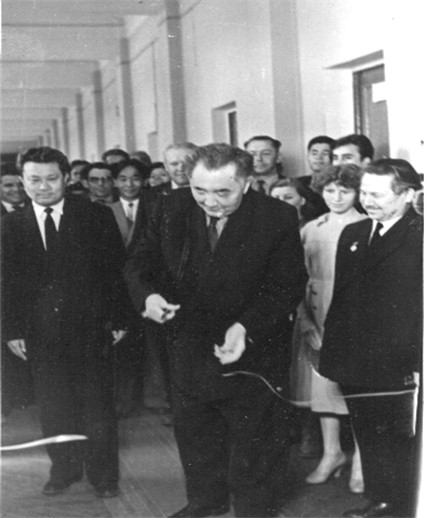
Photo 1. K.I. Satpayev at the opening ceremony of the Nature Museum
Scientists Who Participated in the Opening of the Museum
Nurumov Tulegen Nuralievich was appointed Director of the Museum of Nature in 1957. The first director, T. N. Nurumov, together with leading researchers from the laboratories of paleozoology, entomology, parasitology, and helminthology, played an active role in the creation of the museum’s exhibitions.
Specialists in the restoration and reconstruction of ancient vertebrate skeletons — L. A. Maidanovich, B. M. Kinashev, and I. M. Dergachev — also made significant contributions. Taxidermists who prepared stuffed specimens of modern animals, E. F. Rodionov and T. Asemkulov, were actively involved in the development of the museum collections and displays.
From 1974 to 2018, Candidate of Biological Sciences Tleuberdina Piruza Ablaevna served as Head of the Museum of Nature. In the late 1970s and early 1980s, zoologist-taxidermists Arend G., Zhuiko B., Morozov V., and Goloshchapov A. worked at the museum. Thanks to their efforts, the zoological collections were significantly expanded.
Reconstruction (1985–1986)
In 1985–1986, the museum underwent reconstruction.
A New Stage of Development
Since the mid-2010s, a new stage began in the history of the Museum of Nature. By order of the Ministry of Education and Science of the Republic of Kazakhstan, responsibility for the restoration of the museum was assigned to the Institute of Zoology. The museum now operates as part of the Republican State Enterprise Gylym Ordasy under the Science Committee of the Ministry of Education and Science of the Republic of Kazakhstan.
In mid-2012, the Paleontological Hall of the Museum of Nature was restored and reopened to visitors in honor of International Museum Day.
In 2019, by order of the director of the Republican State Enterprise Gylym Ordasy, PhD Nazymbetova Gulzhan Shaizatovna was appointed Head of the Museum of Nature. Under her leadership, the exhibitions were reorganized into biotopic groups, and landscape-based floor dioramas were created, including: “Dry Aquarium,” “Mountain Landscape,” “Forest-Steppe,” “Desert,” and “Water Landscape.”
Entomological exhibitions were also further developed.
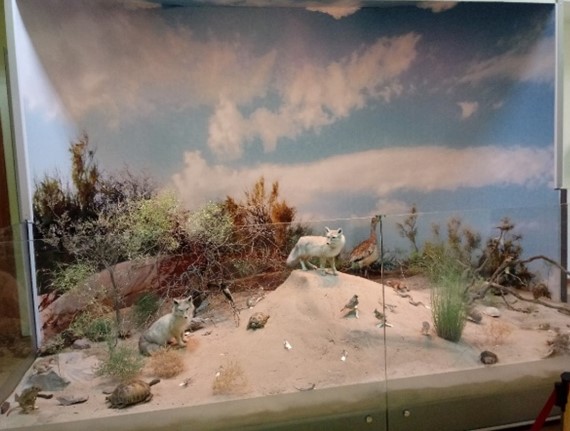 Figure 2. Desert Landscape |
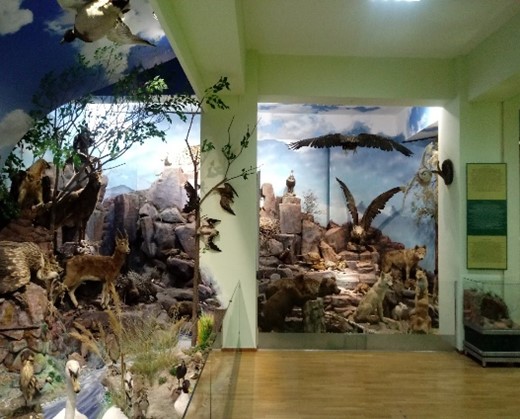 Figure 3. Mountain Landscape |
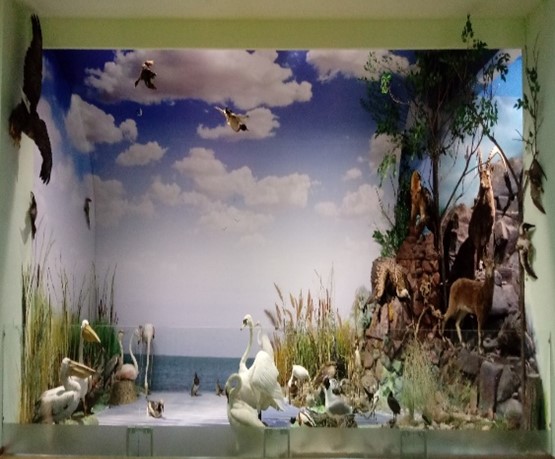 Figure 4. Aquatic Landscape |
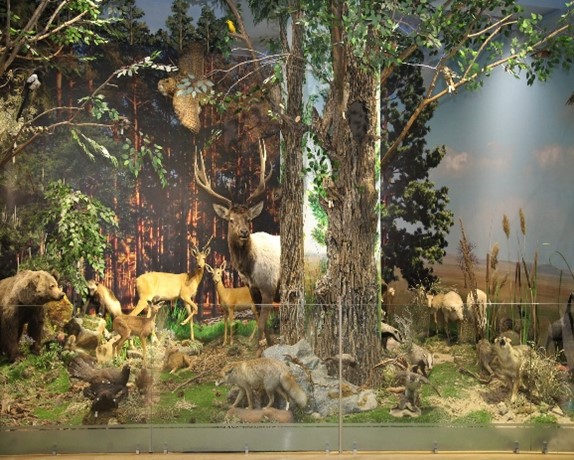 Figure 5. «Forest - Steppe» exhibition |
Replenishment of the Museum Collection
From 2023 to 2025, the Museum of Nature was closed for construction work carried out in the building of Gylym Ordasy. Since October 2025, the Paleontological Hall of the Museum of Nature has reopened to visitors.