Ғылым ордасы
RSE «Gylymordasy» Museum of the history of Science of Kazakhstan

About the museum


The Museum of the history of science of Kazakhstan was established on the basis of the resolution of the Government of the Republic of Kazakhstan No. 84 dated February 11, 2010 "on some issues of Republican state-owned enterprises of the Science Committee of the Ministry of Education and science of the Republic of Kazakhstan" and the Order of the Science Committee of the Ministry of Education and science of the Republic of Kazakhstan No. 35 dated June 1, 2010 "on the creation of the Science Museum "of the Republican state enterprise on the right of economic management" Gylym ordasy". This museum is the first institution that tells about the history of Science in Kazakhstan, created in order to study and demonstrate the long – term history of science of our state. The main purpose of the museum is the collection, storage, study and presentation to the public of physical, written, handwritten, Pictorial, Film, photo, phonodata describing the state of Science of Kazakhstan from the beginning to the present and describing the scientific, state, public and cultural activities of figures of domestic science and culture.

IMG
The main tasks of the Museum of the history of science of Kazakhstan

1. study of the process of emergence, formation and development of Science in Kazakhstan; 

2.Organization of search work on the history of Science of Kazakhstan, Organization of business trips, equipment, systematization, storage, research of funds from the collected data; 

3. Conducting research and educational work in the Museum and outside the museum; organizing lectures, excursions, Museum classes, meetings with representatives of the field of science; 

4.Preparation of the matic and Exposition plans, Organization of expositions and exhibitions; 

5. Promotion of the history of Kazakhstan's science; 

6. Implementation of publishing works; 

7. Organization of conferences, seminars, exhibitions, formation of a scientific and methodological base; 

8. Establishment of research and cultural relations with profile institutions of Kazakhstan, near and far abroad.

Today, the Museum conducts research on the history of Science of Kazakhstan in the direction of scientific research; together with scientists, research institutes, identifies cultural, historical and artistic values of exhibits and introduces them into scientific circulation; organizes scientific and search trips to museums, libraries, archives, etc. institutions of Kazakhstan, near and far abroad. In the field of exposition and exhibition work, the museum conducts scientific and educational work on the formation and development of Kazakh science; expositions and exhibitions are organized. In the field of cultural and educational work, it organizes excursions, events for students, researchers, museum workers and visitors interested in the history of the development of Science in Kazakhstan; meetings with representatives of the domestic field of science, mobile exhibitions on the eve of significant anniversaries; prepares guides, catalogs of museum exhibits and expositions, booklets, bibliographic reference, annotations, articles and scientific publications. In the field of museum fund work, work is carried out to collect and equip the museum fund with relevant exhibits; create the necessary conditions for the preservation of the main and auxiliary funds; keep stock records; take the necessary measures to ensure the safety of museum objects and exhibits; prepare an electronic database on museum funds.

11067

Take the necessary measures to ensure the safety of museum objects and exhibits

6617

Prepare an electronic database on museum funds

4450

Create the necessary conditions for the preservation of the main and auxiliary funds

Museum exposition

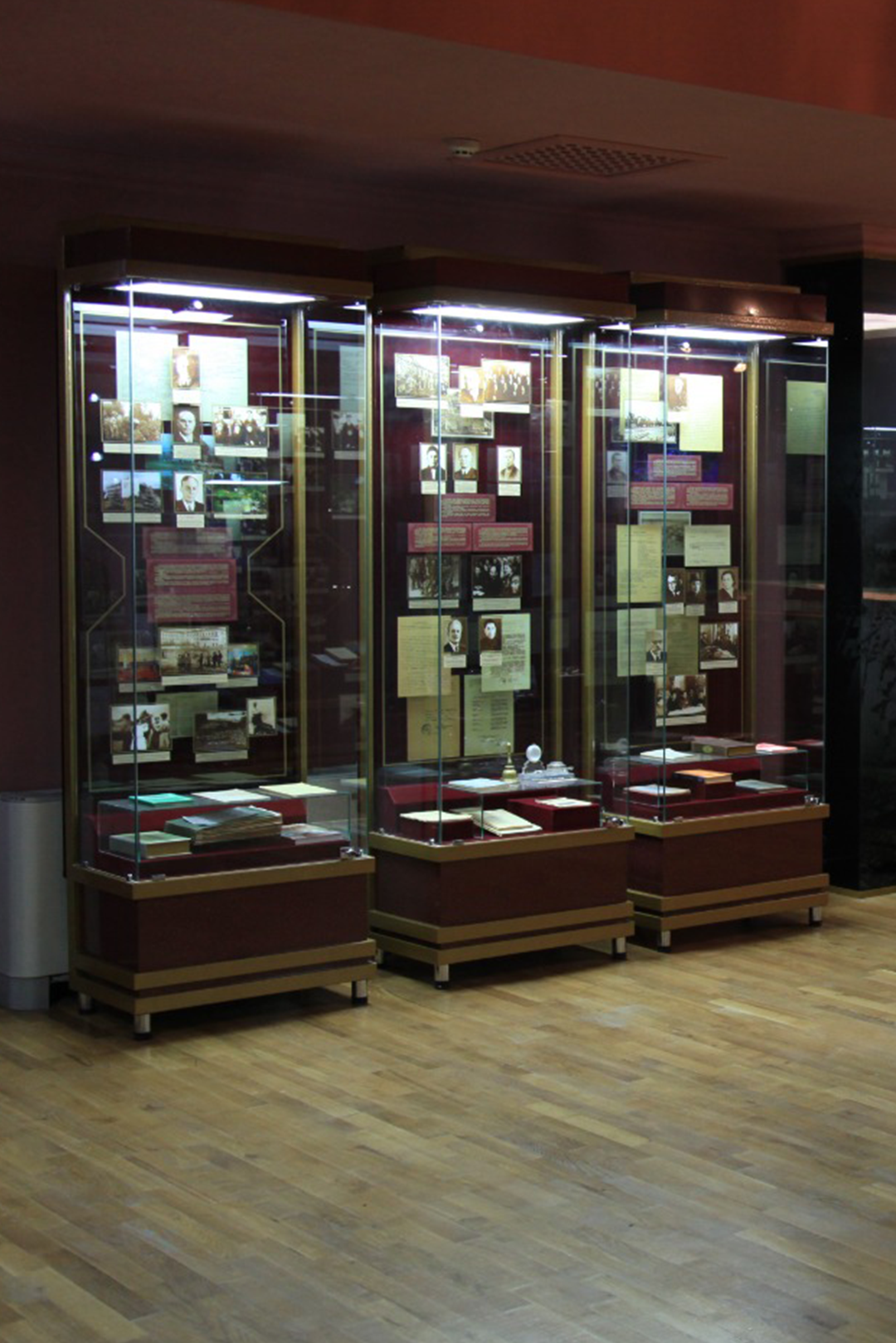
The museum consists of three exhibition halls that reflect the history of the formation and development of the domestic science industry:

1. Sources of antiquity of Kazakhstan's science. The emergence of Science in Kazakhstan. Enlightenment scientists of the XIX century.

2. Development and formation of Science in Kazakhstan in the Soviet era.The history of the National Academy of Sciences of the Republic of Kazakhstan, the achievements of its presidents K. I. Satpayev, D. A. Kunaev, Sh.Shukin, Sh.Yessenov, a.m. Kunaev, M. Aitkhozhin, U. M. Sultangazin, K. Sagadiyev and our scientists who contributed to the development of science of the country, the history of the development of research institutes are presented..

3. Science of independent Kazakhstan.

The number of exhibits is more than 11 thousand.

In the section "sources of the ancient era of Kazakhstan's science", the first Exposition Hall presents the cultural heritage of the Saks tribes who lived in the territory of Kazakhstan in the first millennium BC, samples of written monuments of the ancient Turkic era. The museum's exposition also presents the works of outstanding scientists of the medieval East who lived on the territory of our country. In particular, the works of Abu Nasr Al-Farabi, who became the " second teacher of the world", are of particular interest. Further, the Eastern scholars who lived in the Middle Ages and their works are shown: Ulugbek, the first founder of Central Asia, Abu Ali Ibn-Sina, Muhammad ibn Musa Khorezmi, Abu Raikhan Al-Biruni, Joseph Balasagun, Mahmut Kashgari and the creator of Sufi teachings Khoja Ahmed Yasawi, etc. Many sources write that the city of Otrar had one of the largest libraries in Central Asia, and Al-Farabi himself began to collect it. The museum depicts a view of the shopping street of the city from the Otrar library.

The exposition dedicated to the activities of Russian researchers and the Russian Geographical Society, who studied the Kazakh steppes in the XVIII-XIX centuries, presents a geographical map of the settlement of Kazakhs", scientific works by I. Levshin, P. I. Rychkov, V. V. Bartold, V. V. Velyaminov-Zernov, P. P. Semenov-Tyan-Shansky and others..They collected valuable data on the history, ethnography, language and traditions of the Kazakh steppe and laid the foundation for the scientific study of Kazakh culture. In addition, the Hall highlights the activities of the Russian Geographical Society – this society has comprehensively studied Kazakhstan in geographical, natural-historical and ethnographic terms.

In addition, the exposition presents the works and photographs of such scientists as Shokan Ualikhanov, Abay Kunanbayuly, Ibray Altynsarin, among the Kazakh educators of the XIX century. There are many facts about the contribution of these persons to the development of literacy of the Kazakh society.

The second exposition hall, called" development and formation of Kazakhstan's Science in the Soviet era", contains a lot of information about prominent representatives of the Alash movement, who served in the early twentieth century to awaken enlightenment and national consciousness in Kazakh society. This Hall presents valuable facts and exhibits about the life and work of such national intellectuals as Alikhan Bukeikhan, Akhmet Baitursynov, Mirzhakip Dulatov, Zhusupbek Aimauytov, Magzhan Zhumabayev, their contribution to the independence and cultural development of the Kazakh people. Historical photographs of Alash figures, articles published in the press, books and other archival materials show their contribution to the future of the nation in detail.

The exposition of our museum, dedicated to the development of domestic science in the Soviet period, tells about the history of the Academy of Sciences of the Kazakh SSR since the establishment of the Kazakh base of the Academy of Sciences of the USSR in 1932.The exposition covers the life and work of Kanysh Satbayev, who was the founder and first president of the Academy of Sciences of the Kazakh SSR. The textbook "algebra", written in 1924 by the scientist who founded the school of metallogeny in Kazakhstan, his works on the path of science, photographs and other personal belongings are presented to the public. The exposition includes photographs and personal belongings of the first academicians and correspondents of the Academy of Sciences of the Kazakh SSR in 1946, as well as sections of the Academy. There is an opportunity to learn more about the history of the formation of Kazakh Science in the Soviet period through materials about scientific achievements, fundamental research and projects of institutes, archival documents, photographs and historical exhibits. Of particular interest is the printing press of Ismet Kenesbayev, one of the first academicians of the Academy of Sciences, the founder of Kazakh language education. The printing press "Rheinmetall", produced in Germany in the 40s of the XX century, was created on the basis of the Kazakh alphabet. In the second Hall of the museum there is a model of the building of the National Academy of Sciences of the Republic of Kazakhstan, built from 1951 to 57 by the architect, three-time winner of the Stalin Prize, academician A. Shchusaev.

The third exhibition hall of the museum is called "science of independent Kazakhstan". This hall shows the most important achievements and successes achieved in the field of domestic science in the years after the country gained sovereignty. The exposition is grouped in three main areas: Biological Sciences, Technical Sciences and humanities. In each direction, valuable materials about research work, discoveries and inventions of Kazakhstani scientists are presented. The exposition reflects the works of outstanding scientists who have contributed to the science of our country and their discoveries, modern scientific tools and technological achievements. In addition, biological research conducted in Kazakhstan, innovations in the field of technology and engineering, as well as scientific achievements in the humanities, such as history, language, literature and philosophy, are also covered in detail. This hall demonstrates the scientific potential of independent Kazakhstan and the branches of science that are developing in accordance with modern requirements with an innovative approach.

Today, the Museum of the history of Science of Kazakhstan continues to acquaint residents and guests of Almaty with the history of the formation and development of domestic science. Every year, the museum fund is replenished with items of famous Kazakhstani scientists and academics. In addition, the museum staff also works in the research, cultural and educational areas of the museum. The only museum dedicated to the history of Science in the country is of great importance in increasing the interest of the younger generation in their history, instilling patriotism and patriotism.


Unique exhibits

  • This is the personal binoculars of the outstanding statesman and public figure of Kazakhstan, three-time hero of Socialist Labor, academician Dinmukhamed Kunayev. This valuable exhibit was presented to the museum on July 23, 2010 by his nephew Diar Kunaev.

  • This is a printing press used by the founder of Kazakh linguistics, the famous academician Ismet Kenesbayev. This is an office typewriter made by special order in the German concern "Rheinmetall". Its main feature is that it is based on the Kazakh alphabet. This ancient printing device was one of the main tools used by the scientist for research and writing phonetic and lexicographic works of the Kazakh language. This writing machine is of particular interest not only for its scientific significance, but also as a valuable cultural heritage in relation to the history of the science of the national language.

  • One of the next unusual exhibits is a souvenir in the form of a pyramid made of mineral stones. This exhibit belongs to the academician of the Academy of Sciences of the Kazakh SSR, doctor of technical sciences, professor Shapyk Shokin, who was president of the Academy of Sciences of the Kazakh SSR in 1964-1967.The souvenir, made of 166 natural minerals found in Kazakhstan, was presented to the academician by Engineer P. N. Komorov in 1966.

  • A laptop presented by professors of Kyoto University to Sultangazin Umirzak Makhmutovich, doctor of physical and mathematical sciences, professor, who served as president of the Academy of Sciences from 1988 to 1994.In 2010, this valuable exhibit was presented to the museum by his wife Raikhan Ganievna.


Exhibitions and events
News